


Healthcare Quarterly, 29(Special Issue) November 2026: 46-56.doi:10.12927/hcq.2026.27964
Improving Equity in Access to Palliative Care
Many Paths, Walking Together: Honouring Collective Reflections in Indigenous-Centred1 Palliative Care in Canada


Abstract
The Improving Equity in Access to Palliative Care collaborative supported five Indigenous-centred initiatives across Canada (2024–2026) that strengthened access to palliative care for First Nations, Inuit and Métis experiencing vulnerable housing and systemic barriers to care. Grounded in relationships and Indigenous Knowledge systems, the initiatives showed palliative care is more than clinical support. It is also cultural and community-based. Together, the initiatives demonstrated that safer, high-quality and equitable care is most effective when First Nations, Inuit and Métis lead the work, (re)define care in their own ways and support connection to culture, family, community and self-determination.
Key Takeaways
- Gaps in access to palliative approaches to care for First Nations, Inuit and Métis Peoples stem from ongoing colonialism and anti-Indigenous racism, not chance. Improving approaches to palliative care means naming and addressing these harms, building relationships grounded in dignity and cultural safety and supporting community-led approaches rather than top-down systems.
- A whole-person, community-centred approach strengthens equity, safety and quality of palliative care by building on community strengths, respecting diverse ways of knowing and recognizing Indigenous Knowledge translation such as storytelling, metaphors and expressive arts as a valid and meaningful form of evidence and impact.
- Using a decolonizing and equity-focused approach to evaluation for the Improving Equity in Access to Palliative Care collaborative helped address the systemic barriers and inequities that shape people's experiences of care. It also supported First Nations, Inuit and Métis communities to share their own stories, in their own ways, and carry that knowledge forward for future generations.
- Making evaluation an integral part of ongoing learning and improvement helps to create palliative care systems that are more just, inclusive and responsive to the needs, values and priorities of the people and communities they serve.
Introduction
People experiencing housing insecurity2 often face multiple and interconnected challenges including poverty, isolation, substance use and mental health struggles, all of which can contribute to poorer health and earlier death. When basic needs such as safe housing are unmet, it becomes much harder to support physical, emotional, mental and spiritual well-being (Bulle and Dosani 2026). These realities are often made worse by discrimination and barriers within mainstream healthcare systems (Stajduhar 2026; Stajduhar and Gott 2023).
In Canada, these inequities are closely tied to colonization. First Nations, Inuit and Métis Peoples are overrepresented among people experiencing homelessness or vulnerable housing because of land dispossession, violence, intergenerational trauma and ongoing anti-Indigenous racism (Gabriel 2023). These experiences are interconnected and continue to shape quality of life and access to healthcare (Prince 2026).
The Improving Equity in Access to Palliative Care (IEAPC) collaborative was launched in 2022 to respond to these realities and increase access to palliative approaches to care for people experiencing homelessness or vulnerable housing. The collaborative was a shared effort to do things differently. Rather than relying on top-down models, the collaborative focused on building relationships, listening to communities and supporting local leadership. It brought together people across Canada who are working to make palliative approaches to care more accessible, equitable, safer and higher quality for people too often excluded from care.
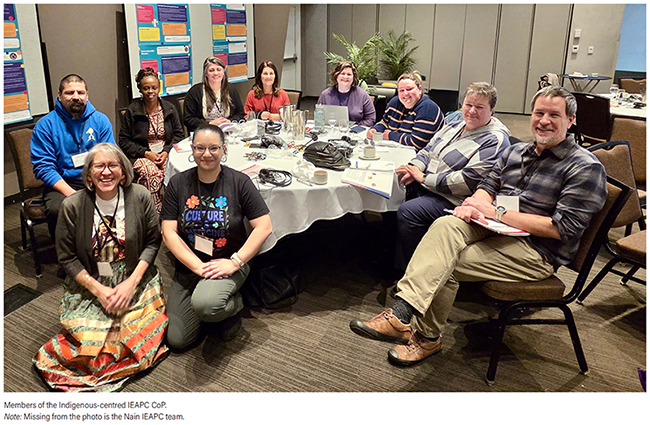
Many Paths, Walking Together brings together shared learnings, outcomes and promising practices from five of the 23 initiatives. Indigenous-centred IEAPC initiatives worked with and served First Nations, Inuit and Métis Peoples and communities. Together, they formed a community of practice (CoP) and chose the name “Indigenous-centred IEAPC CoP”3,4 to reflect their shared commitment to centring First Nations, Inuit and Métis ways of knowing, being and doing.
The article also explores how the IEAPC as a collective collaborative took a decolonizing approach to using the IEAPC Evaluation Framework. This meant going beyond including Indigenous perspectives in an existing framework to centring Indigenous Knowledge, relationships, values and ways of working in how the framework was understood and applied. This article outlines the IEAPC collaborative's decolonizing approach, shares key findings from the five Indigenous-centred IEAPC initiatives and the CoP, and explores one Indigenous-centred IEAPC initiative in greater depth. It concludes by considering what these findings mean for palliative care.
Decolonizing and Equity-Centred Evaluation
The IEAPC collaborative chose to co-create an evaluation approach rooted in decolonization and equity: shaped by people with diverse lived experience, scholars and practitioners in palliative care and related health equity spaces. It focuses on three key areas: making care more equitable, making care safer and improving the quality of palliative care while creating space for reflection, shared learning and ongoing adaptation (IEAPC Program Delivery Team 2026). It was developed in such a way that it could be used by communities looking to take a decolonizing approach to evaluation (HEC and CPAC n.d.). It was designed for use for the collaborative, while there was recognition that it may be useful to others in their work and thus is publicly accessible and available through HEC (HEC and CPAC n.d.).
A decolonizing approach to evaluation means supporting First Nations, Inuit and Métis Peoples' self-determination and shifting decision-making power back to communities (Cohen-Fournier et al. 2021; Rix et al. 2019). It challenges settler-colonial evaluation practices that have historically excluded or undervalued Indigenous Knowledge systems, cultural practices and languages. Instead, it places First Nations, Inuit and Métis perspectives, priorities and definitions of impact at the centre of evaluation (Bremner and Bowman 2023; Dodge Francis et al. 2023; Firestone et al. 2020; Fraser 2022; Hurlbut and Brousselle 2023; Iseke 2013; Locklear et al. 2023; O'Connor et al. 2023). An equity-centred approach to evaluation recognizes how colonization, racism and other systemic inequities shape people's access to care, participation and outcomes. It ensures that people most affected by these inequities help shape the questions, methods and meaning of the evaluation. This includes attention to the experiences of people facing homelessness or vulnerable housing and the ongoing effects of anti-Indigenous racism in healthcare and social service systems.
For the five Indigenous-centred IEAPC initiatives, evaluation was not about proving success or failure. It was about learning together by asking:
- What matters most to communities?
- What has changed?
- What are we learning?
- How can Indigenous-centred palliative approaches to care continue to grow in meaningful ways?
Using a decolonizing and equity-centred approach to evaluate the five Indigenous-centred IEAPC initiatives supported the sharing of stories in ways that went beyond checklists and reporting requirements. Their evaluation approach focused on learning, relationships and community leadership rather than judging or extracting information. It grounded evaluation in fairness, respect and the lived realities of First Nations, Inuit and Métis Peoples (Cohen-Fournier et al. 2021; Rix et al. 2019).
A Shared Journey
Supporting community leadership and building local capacity were at the heart of the IEAPC collaborative model. Support for the Indigenous-centred initiatives included:
- Co-created group safety guidelines: As a CoP, the five initiatives co-developed shared guidelines to help create a respectful space for listening, learning and open dialogue. The focus was on curiosity, reciprocity and relational accountability, with everyone sharing responsibility for supporting one another.
- Coaching and evaluation support: Coaches walked alongside teams rather than directing them. Their role was to support local leadership, knowledge and community priorities, not to lead the work.
- Workshops and gatherings: Online and in-person gatherings created opportunities to build trust, share stories and learn from one another. Learning was grounded in relationships and shared experience rather than hierarchy or top-down approaches.
- Community-based site visits: Visits helped ground the work in lived experience and create space for ceremony, storytelling and reflection, while recognizing the harms many First Nations, Inuit and Métis Peoples have experienced in healthcare systems. Indigenous Knowledge systems were treated as essential.
- Peer learning and collaboration: Teams learned with and from one another through peer support, deep listening and relationship building.
- Sharing circles: Sharing circles created respectful, non-judgemental spaces for discussing challenges, making decisions and strengthening connection.
- Reflective practice: Team members were encouraged to reflect on how they show up in their work and relationships with First Nations, Inuit and Métis communities. This included building self-awareness, examining power and privilege, supporting one another and advocating for equitable, culturally safer care.
- Elder involvement: Elders helped ground the work by supporting connections to land, place, community and shared responsibility in palliative care work alongside First Nations, Inuit and Métis Peoples.
- Arts-based and story-based approaches: Activities such as creating infographics, talking sticks, rock paintings, collages and zines supported knowledge sharing beyond written reports and formal research methods.
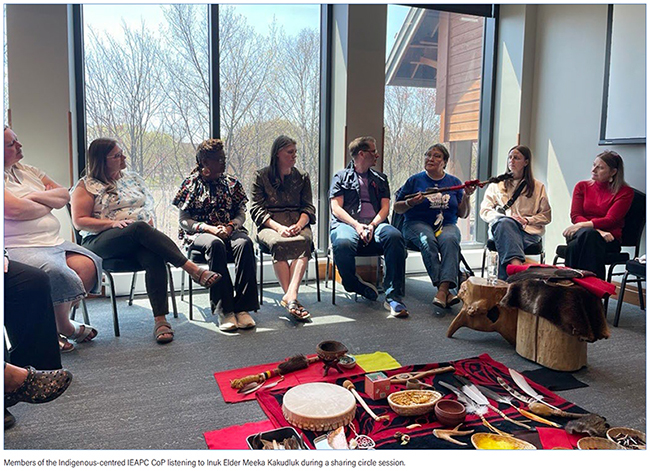
The Framework in Action
Across Alberta, Ontario and Newfoundland and Labrador, the initiatives showed that palliative approaches to care are not only clinical care. They are relational, cultural and grounded in community, land, language and ceremony. Rather than designing programs for communities, this work was created with communities and guided by local knowledge, lived experience and relationships.
Stories, images, expressive arts and shared experiences were central to understanding impact. These approaches honoured Indigenous ways of knowing and helped communities identify what was working, what needed to change and how care could better support dignity, connection and choice across the continuum of care. In Table 1, what follows is a snapshot of the five initiatives:
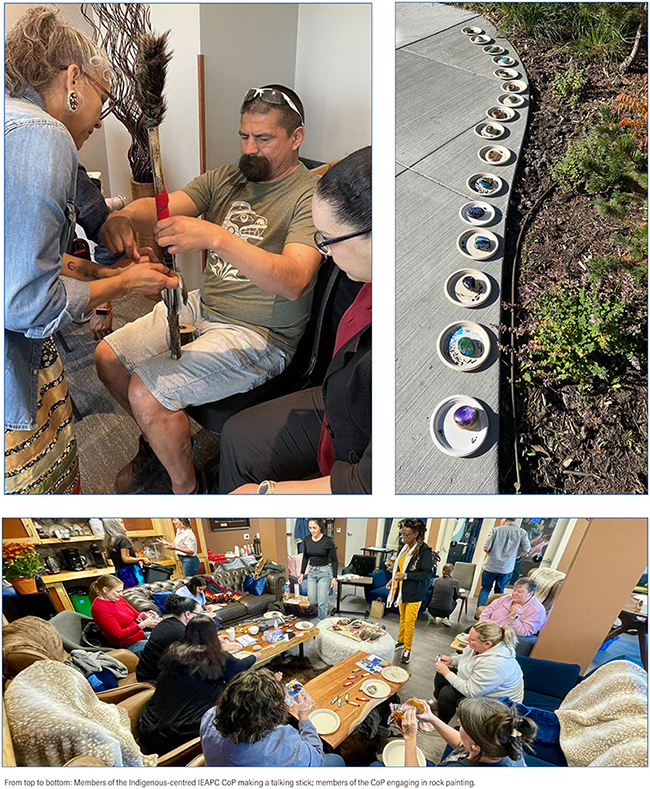
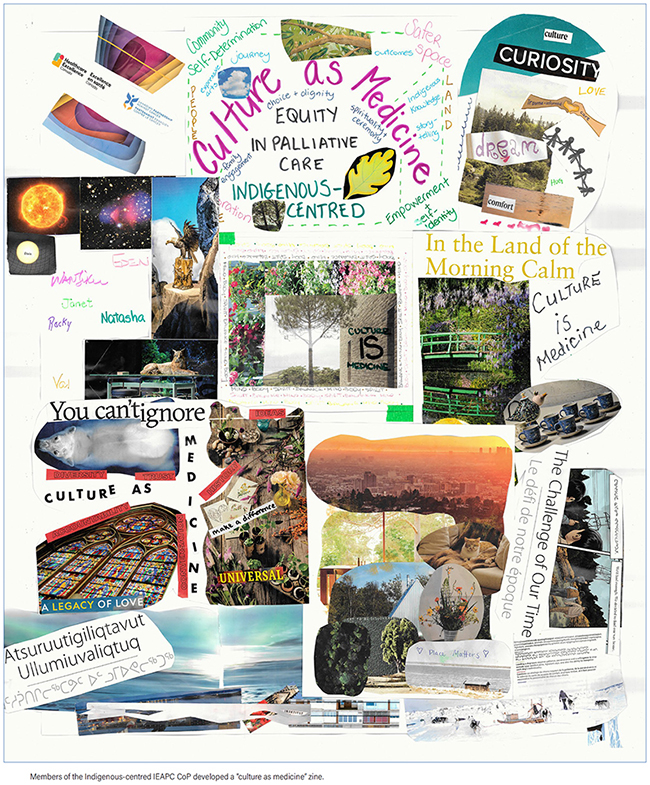
| TABLE 1. Snapshot of the five Indigenous-centred IEAPC initiatives (2024–2026) | ||||
| Initiative | Where it took place | What it was about | Evaluation methods | What changed |
| Culture as Medicine: Journeying with an Indigenous Palliative Care Auntie (Edmonton, AB) | Homes, shelters, hospitals, community spaces | Relationship-based care led by an Indigenous Palliative Care Auntie, grounded in trust, presence and connection to culture, ceremony and community Included smudging, pipe ceremonies, traditional songs, time on the land, working with medicine and connecting with Elders and Knowledge Keepers |
Indigenous Knowledge translation (storytelling, metaphors, expressive arts) Care satisfaction surveys Testimonials and feedback from the Palliative Care Auntie, community partners, patients and families |
Patients reported:
|
| Gathering Voices, Honouring Care: A Journey in Culturally Safer Palliative Care (Bonnyville, AB) | Community gathering spaces, homes, care settings | Partnership between AHS and Cold Lake First Nations focused on listening, shared learning and shaping palliative approaches to care together Included community engagement and related trauma-informed care sessions |
Indigenous Knowledge translation (storytelling, metaphors, expressive arts) Self-reported feedback and testimonials from this IEAPC team (members of the AHS and Cold Lake First Nations) |
IEAPC team (members of the AHS and Cold Lake First Nations) reported:
|
| ONGWEHÓN:WEH: All Indigenous Peoples and the Journey Home (Fort Erie, ON) | Community-based settings | Partnership between Fort Erie Native Friendship Centre and Hospice Niagara to co-create a peer support training program grounded in trust, cultural safety and supporting people through serious illness, dying and grief | Indigenous Knowledge translation (storytelling, metaphors, expressive arts) Self-reported feedback from team (members of the Fort Erie Friendship Centre and Hospice Niagara) and peer support-trained volunteers and helpers |
IEAPC team (members of the Fort Erie Friendship Centre and Hospice Niagara) and peer support-trained volunteers and helpers reported:
|
| Our Collaborative Journey: Culture as Medicine in Palliative Care (Nain, NL) | Homes, community, clinics, hospital | Community-driven approach supporting palliative care close to home, grounded in culture, family and choice Included training and community engagement dialogue sessions |
Indigenous Knowledge translation (storytelling, metaphors, expressive arts) Self-reports from team, along with feedback and testimonials from families and providers |
IEAPC team, families and providers reported:
|
| Walking Through the Doorway: Inuit Knowledge Guiding Palliative Approaches to Care (Ottawa, ON) | Community agencies, congregate settings, hospice | Inuit-centred approach grounded in relationships, storytelling and cultural and spiritual care Included training sessions, community engagement and journey mapping conversations |
Indigenous Knowledge translation (storytelling, metaphors, expressive arts) Self-reports from team and feedback from community members, care providers, caregivers and organizational partners |
IEAPC team and feedback from community members, care providers, caregivers and organizational partners reported:
|
| AB = Alberta; AHS = Alberta Health Services; IEAPC = Improving Equity in Access to Palliative Care; NL = Newfoundland and Labrador; ON = Ontario. | ||||
Learnings From the Indigenous-Centred IEAPC CoP
An important aspect for these five initiatives was their work via the CoP.4 This was more than a series of meetings. It bec ame a circle for sharing stories, supporting one another and learning together. Elders, Knowledge Keepers, direct care workers, researchers, healthcare providers, people with lived experience and community leaders all contributed to this shared learning space.
Across the CoP, one message became clear: palliative approaches to care must reflect people's real lives. When care honours culture, language, ceremony, land, family and community, people are more likely to feel safe, respected and supported. Relationships, trust, humility and listening were at the heart of this work.
Conversations with members of the CoP highlighted how the CoP created space for First Nations, Inuit and Métis learning where teachings, experiences and approaches to palliative care could be shared in a good way. As one CoP member stated, “The Indigenous-centred IEAPC community of practice was a key part of our work. It was about many paths coming together.” Others shared how they each brought their own experiences and knowledge to a space centred on connection to culture, land, community and spirit. CoP members spoke of how the united focus supported them in exploring what Indigenous-centred palliative care looked like in their own contexts: “We were all walking in the same direction: toward palliative care that is more just, more connected and more grounded in the strengths of the communities we serve.”
This work showed that culturally grounded, community-led palliative approaches to care can create safer, more equitable systems of care. Continuing this work means following the leadership of First Nations, Inuit and Métis communities, valuing Indigenous Knowledge systems equally and committing to ongoing learning, relationship building and change.
Sharing a Case Study in Indigenous-Centred Palliative Care
Storytelling, metaphors and expressive arts were central to the evaluation process. They were not simply ways to explain ideas. They were ways of knowing, learning and sharing meaning. Through stories, symbols and lived experience, Indigenous-centred IEAPC initiatives expressed relationships to land, community, culture and one another. In palliative approaches to care, this created deeper and more meaningful understandings of impact.
One example is the Culture as Medicine: Journeying with an Indigenous Palliative Care Auntie initiative, a partnership between NiGiNan Housing Ventures and Kokums Helper Society in Edmonton, Alberta. Led by Jackie DeCoteau-Gill, an Indigenous Palliative Care Auntie,5 the initiative supported people nearing the end of life, many of whom had experienced harm, exclusion or racism within healthcare systems. Jackie DeCoteau-Gill walked alongside people wherever they were in their journey, offering care grounded in trust, relationship, ceremony, culture and community.
This work was not about creating another program. It was about showing up with consistency, compassion and respect. Through Jackie DeCoteau-Gill's work, culture became a living, everyday part of care. Care included sitting at the bedside, helping people get to appointments, sharing food and listening deeply. It also meant creating space for spiritual care and connection to culture through smudging, beading, making baby moccasins and ribbon skirts, sharing traditional songs, round dancing, participating in ceremony and spending time on the land. Furthermore, Jackie DeCoteau-Gill created space to talk, listen and learn from Elders and Knowledge Keepers, supporting people through grief and helping people reconnect with themselves, their communities and their ancestors. Activities such as equine therapy, grief circles, storytelling and simply holding hands became part of care and connection. Care took place in hospitals, shelters, housing settings, homes and community spaces, recognizing that palliative care happens wherever people live, gather and connect.
One of the clearest learnings from this initiative was simple: culture is medicine. As an Indigenous Palliative Care Auntie, Jackie DeCoteau-Gill's presence was not separate from care; she was part of the care itself. Ceremony, connection and spiritual care were essential to dignity, comfort and meaning at the end of life.
Feedback from patients, families, staff and partners showed that culturally grounded care helped people feel less isolated, more connected and more at peace. Practical changes emerged, including increased attendance at medical appointments, reduced fear of care and greater inclusion of cultural practices such as smudging, cedar care and traditional songs in palliative care settings.
The initiative also identified priorities for the future, including stable funding for Indigenous cultural care roles, more Indigenous care providers, flexible work structures that honour ceremony and family responsibilities, access to cultural supplies and spaces. As Jackie DeCoteau-Gill shared: “Having an Indigenous person care for Indigenous Peoples … it creates opportunities for learning, for community and for breaking down barriers.”
The following infographic (see Figure 1) centres Jackie DeCoteau-Gill as a guide and Knowledge Carrier. Through symbols such as a ribbon skirt, circles, a rainbow road and scenes from urban and rural Alberta, it reflects connection, transition, community, land and spirit in relation to culturally safer palliative approaches to care.
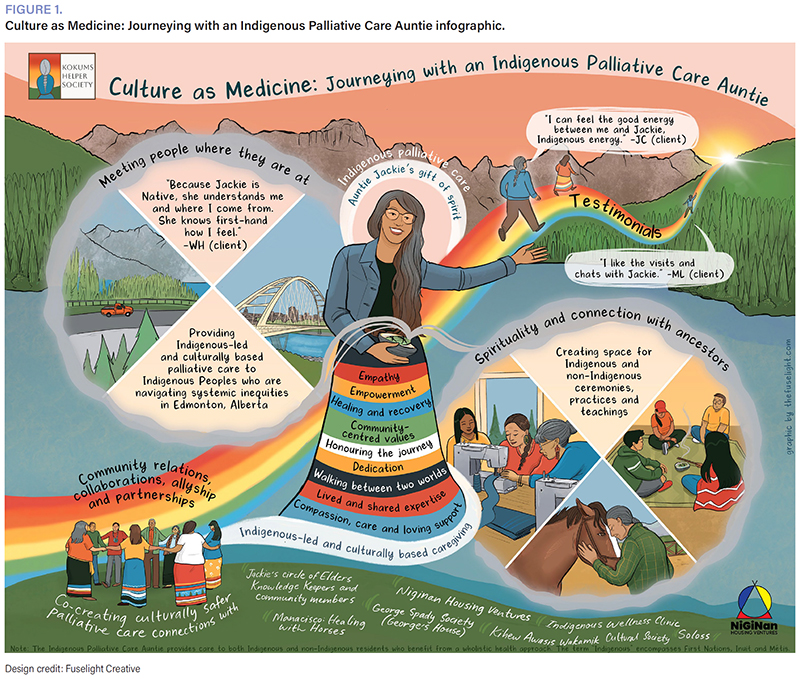
Together, this story and infographic show how Indigenous storytelling, metaphors, expressive arts and community-led evaluation can honour lived experience, centre voices often pushed to the margins and support learning in ways that respect emotional, spiritual and relational ways of knowing.
What Was Learned
As this work grew across the five Indigenous-centred IEAPC teams and their CoP, shared understandings began to emerge.
- Culture is medicine. It is not an add-on. Culture lives in relationships, ceremony, language, land and community, and supports people and families through their continuum of care across the lifespan.
- There is no single path. Each community leads and (re)defines palliative approaches to care in their own way.
As one Indigenous-centred IEAPC initiative lead shared: “Our palliative care initiative did not follow a straight or predictable path, but some shared patterns emerged … We created space to slow down and feel what needed to be felt, without pressure to fix or move quickly … There was a growing ability to name the gaps and systems that cause harm, rather than placing blame on individuals … We also supported reconnection with Inuit culture, language and living history in ways that felt meaningful and self-determined.”
- Stories matter. Storytelling builds connection, shares knowledge and helps people make sense of their experiences.
- Palliative care must be community-led. Communities are decision makers, shaping palliative care based on their own values and knowledge: Communities are not just included; they are decision makers who shape services, guide priorities and define what matters in care.
In Nain, Labrador, Our Collaborative Journey: Culture as Medicine in Palliative Care was grounded in a simple but powerful idea: people should have the choice to remain in their community, surrounded by family, language, land, sea and traditions as they begin their journey into the spirit world. This work required flexibility, patience and respect, while recognizing that community members already carry deep knowledge about how to care for one another.
What Helped This Work Succeed
- Leadership matters at every level. Leadership was not only found in formal roles. Across all five initiatives, people showed leadership through everyday actions and a shared commitment to equity, cultural safety and quality palliative care.
- Time, support and resources are essential. Teams needed time and space to learn, reflect and grow, along with stable funding, people and tools. Building culturally safer care also meant supporting an Indigenous-informed health workforce that understands trauma and centres family and community in care.
For example, the ONGWEHÓN:WEH: All Indigenous Peoples and the Journey Home initiative strengthened relationships between the Fort Erie Native Friendship Centre and Hospice Niagara in Fort Erie, Ontario. Through this partnership, communities and providers shared knowledge and created new ways to support Indigenous Peoples through illness, dying and grief. ONGWEHÓN:WEH: All Indigenous Peoples and the Journey Home trained volunteer helpers, many from local Indigenous communities, to provide palliative care peer support. The initiative also developed practical tools, including training materials and community resources. As reflected by Wanjiku Ngamau-Fulton and Eden Ewert, co-champions of ONGWEHÓN:WEH: All Indigenous Peoples and the Journey Home: “What is clear moving forward is that palliative care is a right. Systems need to better support community leadership, invest in relationships and remove barriers to access.”
- Culture stays at the centre. Palliative care was most effective when culture was recognized as part of healing, not something separate. Ceremony, language, land-based practices and connections to family, community and ancestors were central to care.
- Relationships come first. Meaningful palliative care work depended on trust, respect and reciprocity. The focus was not on taking knowledge from First Nations, Inuit and Métis communities, but on building relationships over time through co-design, shared decision making and honouring lived experience and Indigenous ways of knowing.
As a partnership between Alberta Health Services and Cold Lake First Nations, Gathering Voices, Honouring Care: A Shared Journey in Culturally Safer Palliative Care brought together nurses, physicians, community health workers, Elders, leadership and families into a shared circle of care. Education sessions and community gatherings helped care teams deepen their understanding of grief, trauma and culturally safer care. These gatherings also created space for honesty, where people could share frustrations, build understanding and find solutions together.
- Keep learning and adapting. Teams engaged in reflection, shared learnings, adapted along the way and stayed grounded in community needs, recognizing that every community's journey is different.
What mattered most to the Indigenous-centred IEAPC teams and their CoP was walking together: learning, unlearning and shaping palliative approaches to care in ways that honour spirit, relationships, culture and community. The supports, shared learnings and promising practices in this article can be adapted across different palliative care settings while remaining grounded in local knowledge, relationships and community priorities.
Conclusion
The work of the IEAPC collaborative and, in particular, these five initiatives and their CoP makes clear that the gaps many First Nations, Inuit and Métis Peoples experience in palliative care are rooted in ongoing colonial systems and barriers, not individual circumstances. Meaningful change requires recognizing and addressing these realities.
These initiatives show that palliative approaches to care are about more than services. They are about relationships, dignity and connection to family, community, culture and land. When care is grounded in these values, people are more likely to feel safer, respected and supported.
Throughout this work, relationships, trust, reciprocity and community leadership have been central. Cultural safety is not a one-time action but an ongoing commitment to listening, learning and changing how care is provided. Decolonizing and equity-centred approaches to learning and evaluation also matter. They value Indigenous Knowledge systems, storytelling and lived experience alongside other forms of knowledge and ask whose voices are being centred and who continues to be left out.
There is no single path forward. Each community will (re)define palliative approaches to care in ways that reflect their own strengths, knowledge and priorities. What matters is that communities are supported to lead and that their voices guide decisions at every level.
The path ahead is about continuing to walk together with respect, accountability and care, so that equitable, culturally safer and high-quality palliative approaches to care are available to all First Nations, Inuit and Métis Peoples in ways that honour their lives, identities and connections.
About the Author
Natasha Caverley, PhD, CCC, is the president of Turtle Island Consulting Services Inc. Natasha was the project team lead for the Improving Equity in Access to Palliative Care (IEAPC) first-phase evaluation, the IEAPC Evaluation Framework, and she worked with five Indigenous-centred IEAPC initiatives on implementing the IEAPC Evaluation Framework.
Natasha Caverley can be reached by e-mail at natasha@turtleislandconsulting.ca.
Acknowledgment
I extend my appreciation to the Canadian Partnership Against Cancer and Healthcare Excellence Canada (funders), IEAPC Evaluation contributors (IEAPC Coaches, IEAPC Initiative Teams, IEAPC Evaluation Committee), Indigenous-centred IEAPC initiatives, peer reviewers and Jim MacGregor for sharing their time and expertise with me in co-creating a shared space to discuss a decolonizing and equity-centred approach to evaluating and sharing stories of impact on palliative approaches to care for First Nations, Inuit and Métis Peoples experiencing homelessness or vulnerable housing.
References
Bremner, L. and N. Bowman. 2023. Roots and Relations: Celebrating Good Medicine in Indigenous Evaluation. Canadian Journal of Program Evaluation 38(1): 1–3. doi:10.3138/cjpe.77058-en.
Bulle, S. and N. Dosani. 2026. Reflections on Innovative Models of Palliative Care Delivery. Healthcare Quarterly 29(Special Issue): 29–35. doi:10.12927/hcq.2026.27966.
Cohen-Fournier, S.M., G. Brass and L.J. Kirmayer. 2021. Decolonizing Health Care: Challenges of Cultural and Epistemic Pluralism in Medical Decision-Making With Indigenous Communities. Bioethics 35(8): 767–78. doi:10.1111/bioe.12946.
Dodge Francis, C., N. Bowman and S. King. 2023. Kinship Pathways: Nurturing and Sustaining Resilient, Responsible, and Respected Indigenous Evaluators. New Directions for Evaluation 2023(177): 145–52. doi:10.1002/ev.20537.
Firestone, M., R. Maddox, P. O'Campo, J. Smylie, C. Bourgeois, S. Wolfe et al. 2020. Indigenous Health Service Evaluation: Principles and Guidelines From a Provincial “Three Ribbon” Expert Panel. Canadian Journal of Program Evaluation 34(3): 413–24. doi:10.3138/cjpe.68831.
Fraser, J.E. 2022. Relational Accountability: A Path Towards Transformative Reconciliation in Nursing Education. Quality Advancement in Nursing Education 8(3): 8. doi:10.17483/2368-6669.1360.
Gabriel, M. 2023. Our Home is Native Land: Teachings, Perspectives, and Experiences of Indigenous Houselessness. Canadian Journal of Nonprofit and Social Economy Research 14(S1): 93. doi:10.29173/cjnser574.
Healthcare Excellence Canada (HEC) and Canadian Partnership Against Cancer (CPAC). n.d. Improving Equity in Access to Palliative Care Collaborative Evaluation Framework. Retrieved August 27, 2026. <https://a-ca.storyblok.com/f/850807391887861/e763804b85/ieapc-evaluation-framework-english-web-final-ver-3.pdf>.
Hurlbut, K. and A. Brousselle. 2023. Arts-Based Evaluation. Canadian Journal of Program Evaluation 38(2): 408–16. doi:10.3138/cjpe-2023-0024.
Improving Equity in Access to Palliative Care (IEAPC) Program Delivery Team. 2026. The Power of the Collective: Lessons Learned From Pan-Canadian Efforts to Improve Access to More Equitable Palliative Care. Healthcare Quarterly 29(Special Issue): 36–45. doi:10.12927/hcq.2026.27962.
Iseke, J. 2013. Indigenous Storytelling as Research. International Review of Qualitative Research 6(4): 559–77. doi:10.1525/irqr.2013.6.4.559.
Locklear, S., M. Hesketh, N. Begay, J. Brixey, A. Echo-Hawk and R. James. 2023. Reclaiming Our Narratives: An Indigenous Evaluation Framework for Urban American Indian/Alaska Native Communities. Canadian Journal of Program Evaluation 38(1): 8–26. doi:10.3138/cjpe.75518.
O'Connor, J., M. Parman, N.R. Bowman and S. Evergreen. 2023. Decolonizing Data Visualization: A History and Future of Indigenous Data Visualization. Journal of Multidisciplinary Evaluation 19(44): 62–79. doi:10.56645/jmde.v19i44.783.
Prince, H. 2026. Engaging in a Relational Approach: Addressing Inequities in Access to Palliative Care for Indigenous Peoples. Healthcare Quarterly 29(Special Issue): 15–21. doi:10.12927/hcq.2026.27968.
Rix, E.F., S. Wilson, N. Sheehan and N. Tujague. 2019. Indigenist and Decolonizing Research Methodology. In P. Liamputtong, ed., Handbook of Research Methods in Health Social Sciences (pp. 253–67). Springer. doi:10.1007/978-981-10-5251-4_69.
Stajduhar, K.I. 2026. What Leaders Need to Know About the Design and Delivery of Equity-Oriented Palliative Care. Healthcare Quarterly 29(Special Issue): 57–62. doi:10.12927/hcq.2026.27963.
Stajduhar, K. and M. Gott. 2023. Closing the Health Equity Gap in Palliative Care: The Time for Action Is Now. Palliative Medicine 37(4): 424–25. doi:10.1177/02692163231164729.
Footnotes
1. The Indigenous-centred Improving Equity in Access to Palliative Care (IEAPC) community of practice chose to use the term “Indigenous” to respectfully represent the collective identities of First Nations, Inuit and Métis.
2. In this article, “housing insecurity” is interchangeable with “homelessness” and “vulnerable housing.”
3. The Indigenous-centred Improving Equity in Access to Palliative Care (IEAPC) community of practice (CoP) chose to use the term “Indigenous” to respectfully represent the collective identities of First Nations, Inuit and Métis.
4. A “community of practice” is a group of people who come together around a shared concern or goal. They build relationships, share knowledge and learn from one another through conversation, shared experiences and community wisdom. What matters most is their commitment to learning together and supporting each other in meaningful ways.
5. An Indigenous Auntie is a trusted and respected community member who helps care for, guide and support others. An Auntie may or may not be a biological relative. The role is grounded in relationships, responsibility, knowledge sharing and care. Aunties often share cultural teachings, offer emotional and practical support and help strengthen connection, belonging and community well-being. Their wisdom and leadership are important in keeping communities strong and connected.
Comments
Be the first to comment on this!
You must sign in to comment Sign In or Create an Account to add comments
Related Content
Nursing Leadership
HealthcarePapers
Reflecting on “Beyond the Rainbow”: Advancing 2S/Indigiqueer Health Equity
HealthcarePapers
Rewarding Success: Changing the Paradigm of How Research Is Rewarded