


Healthcare Quarterly, 29(Special Issue) November 2026: 22-28.doi:10.12927/hcq.2026.27967
Improving Equity in Access to Palliative Care
Grief and Bereavement in the Context of Homelessness: Sharing Experiences and Learnings From British Columbia
Joshua Black, Stephanie Laing, Rachel Carter, Sherry Landry, John R. Graham and Eman Hassan


Abstract
We explore the unique experiences of bereavement within the context of homelessness, offering insights from both individuals with lived experience and the community support providers. We describe experiences such as entering homelessness, exposure to deaths, how grief is manifested and coping with grief. In addition, we highlight barriers to effective grief support. To address these barriers, we propose strategies for improving support and share lessons learned from our research on this critical issue. These insights are relevant to pan-Canadian initiatives such as the Improving Equity in Access to Palliative Care and to others looking to improve the quality of palliative care services.
Key Takeaways
- People experiencing homelessness often lack safe spaces to process their grief.
- Many bereavement programs are designed with housed people in mind, highlighting the need for more accessible support.
- Cross-sector collaboration is essential to strengthen bereavement supports for people experiencing homelessness and the community support providers who serve them.
Introduction
The Framework on Palliative Care in Canada recognizes that bereavement support is fundamental to the provision of high-quality palliative care (Health Canada 2018). Bereavement is the period following the death of someone significant in which a person (“the bereaved”) experiences grief and mourning (Collins English Dictionary 2012). Grief encompasses a range of natural responses to loss (such as losing your job, a home or a death), which are unique to each person.
For meaningful progress toward improving access to palliative care on a national scale, access to grief and bereavement services and supports is essential. Drawing on learnings from the recently developed province-wide bereavement action plan in British Columbia (BC) (BCCPC 2023), this article explores the unique grief and bereavement experiences of people experiencing homelessness or vulnerable housing, challenges and barriers to care and opportunities for improvement. These learnings are relevant to pan-Canadian initiatives such as the Improving Equity in Access to Palliative Care (IEAPC) collaborative and to others looking to improve the quality of palliative care services in their community. Throughout the IEAPC collaborative, grief and bereavement support in the context of inequity has been a frequent consideration for models of equity-oriented palliative care.
Not all grief in bereavement is treated equally. Grief is disenfranchised when it is not typically recognized or validated in communities and is not adequately supported (Doka 1989). This can be when the relationship to the deceased, the loss type or the griever is not recognized (Doka 1989). A literature review by Monk et al. (2024) found that bereaved people experiencing homelessness are often not recognized as grievers, as they are not adequately supported in their grief by community organizations, which impairs their ability to cope. This knowledge is reflected in the province-wide bereavement action plan in BC, which has stated the priority of supporting this population (BCCPC 2023).
Not only is the grief of people experiencing homelessness disenfranchised, but the research surrounding the topic of bereavement has been scarce and underexplored. The literature review by Monk et al. (2024) found that most research articles lacked attention to detailed or in-depth explorations of bereavement in the context of homelessness. Despite these limitations, their analysis of the articles identified the importance of providing improved bereavement support for people experiencing homelessness and the important role community service workers have in their support.
To develop a greater understanding of this topic and explore suggestions for future support, the British Columbia Centre for Palliative Care (BCCPC) partnered with the Kelowna Homelessness Research Centre (KHRC) to conduct multiple research studies in this area (with community support workers and those with lived experience of bereavement in the context of homelessness) and develop knowledge translation materials on the topic, such as a free e-learning course and documentary film. We will share some of our reflections and learnings that we have gained on the topic to improve our knowledge and the care provided for bereaved people experiencing homelessness. We encourage readers to consider steps they can take at the individual, organizational and system levels to improve access to timely and effective grief and bereavement supports.
What We Heard About Bereavement in the Context of Homelessness
Entering homelessness
Bereavement is a risk factor for becoming homeless (Black and Landry 2024; Mayock et al. 2021; Monk et al. 2024), with many people connecting their bereavement to the time they felt life “fell apart” (i.e., it was the turning point for transitioning to homelessness). Specifically, this was the case for almost half of the 40 participants from our in-person study in Kelowna, BC. This aligns with previous research by Mayock et al. (2021), in which they found that 43% of the 40 participants reported this same turning point. It may be that their caregiver(s) died when they were children and they had to go into foster care (Black and Landry 2024; Mayock et al. 2021). These children then aged out and needed to live in a shelter. It may also be that the grief following the death was too overwhelming and impacted daily functioning (Black and Landry 2024; Mayock et al. 2021).
Exposure to deaths
While experiencing homelessness, participants with lived experience reported a high volume of deaths among the people they care about. Many of those deaths were sudden and unexpected within their community. This aligns with a previous review by Monk et al. (2024). Those who are community support workers who serve this population have also stated the high exposure to death for this population (Monk et al. 2025; Stajduhar et al. 2019; Whitlock et al. 2025).
How grief manifested
In general, participants with lived experience spoke to us about the impact of grief after a loss, encompassing a wide range of responses, including emotional (e.g., sadness), physical (e.g., sleep changes), behavioural/social (e.g., continuing a bond with the deceased), spiritual (e.g., searching for meaning and purpose after the loss) and mental (e.g., dreams and nightmares).
Coping with grief
As noted, bereaved people experiencing homelessness are often unrecognized and unsupported grievers (Monk et al. 2024). People experiencing homelessness tend to seek support from those around them, with those they trust, including their family, friends, pets and community service workers (Black and Landry 2024; Monk et al. 2024, 2025). Formal grief service providers in their community were the least likely to be used, often because of participants' experiences of stigma and mistrust of available support. Bereaved people experiencing homelessness are often estranged from networks of support, leaving them to process their grief in isolation (Monk et al. 2024). It has been reported by staff and those with lived experience that using substances is a common way of managing their grief (Black and Landry 2024; Monk et al. 2024, 2025).
Challenges and Barriers to Support
Participants in our various research studies identified different challenges and barriers to support (Black and Landry 2024; Monk et al. 2024, 2025). Key themes expressed by those with lived experience included the following:
- Financial and structural challenges. Having to navigate difficult circumstances, both financial and structural, means they have additional barriers to processing their grief and may miss out on experiences that would help them honour and remember the deceased. For example, not being able to attend a funeral, the inability to have a permanent memorial or the inability to keep items that would help them maintain a continued connection with them (e.g., photos or objects). They can also have fewer opportunities to safely grieve, as their living circumstances can include unpleasant and unsafe shelter conditions, a lack of privacy and additional grief and trauma that occur regularly.
- Limited services and resources. There are limited services and resources available to this community, with most of the available bereavement services designed for those who are housed, who speak English and who do not have the complex service needs common among those experiencing homelessness (e.g., mental health disorders, trauma, substance use, multiple deaths or a lack of safety and basic needs). Available formal grief support options typically do not feel safe for many people who are experiencing homelessness (e.g., institutional mistrust from their years of negative experiences where they were judged or disrespected). In addition, many community support workers tend to have limited grief and bereavement literacy to support their clients (Monk et al. 2024, 2025).
- Inaccessibility of services. Grief services are not often accessible to people experiencing homelessness. Services can require them to have phone or Internet access, which can present challenges with communication and follow-up. In addition, available support can have long waitlists, involve financial constraints, require them to travel or have no place to store their belongings, leading to fears of theft.
Opportunities to Improve Grief Support
Given that bereavement support is so limited in this community, it is essential to recognize that even a small step forward in offering support can make a significant difference when people are accustomed to having few opportunities. It is important when we think about support that we never force anyone to discuss their grief if they are not ready. Many of the support options that those with lived experience discussed wanting were less about needing traditional talk-based support groups or therapy and more about needing improved opportunities to have grief support conversations with people they trust (e.g., community or outreach workers), memorials or non-verbal outlets for their grief (e.g., art or gardening).
One way to increase the confidence of community support workers in discussing the topic is to provide additional training in this area (including how to support a client grieving, resources available and exploring client preferences), which was recommended in our research by those with lived experience and support workers (Black and Landry 2024). One free e-learning course that could be of benefit to organizational staff is “Fostering Grief and Bereavement Literacy in the Workplace for Those Who Serve People Experiencing Homelessness.” It includes four modules that will help workers learn more about grief and bereavement, how to support a client grieving, grief in the workplace and self-care. A link to the course can be found at whitecart.ca.
Another approach to support those grieving who are experiencing homelessness is to develop a memorial space that people can go to honour the deceased when they would like to and have a yearly service to honour the grief that they carry. Those with lived experience expressed that they use memorials as a way of coping, and they would appreciate more opportunities for that (Black and Landry 2024; Monk et al. 2024, 2025). While considering implementation, it is important to include partners from different organizations (e.g., partnerships between housing services/shelters and grief organizations) to reduce the burden of taking on the full responsibility, and it is essential to ask those with lived experience what they would like to see (Black and Landry 2024). From our research, the creation of any memorial space should incorporate a way for others to add names to it. This could be the ability to write the name in a memorial book, on a wall in a mural or on a tag that can be hung on an art piece.
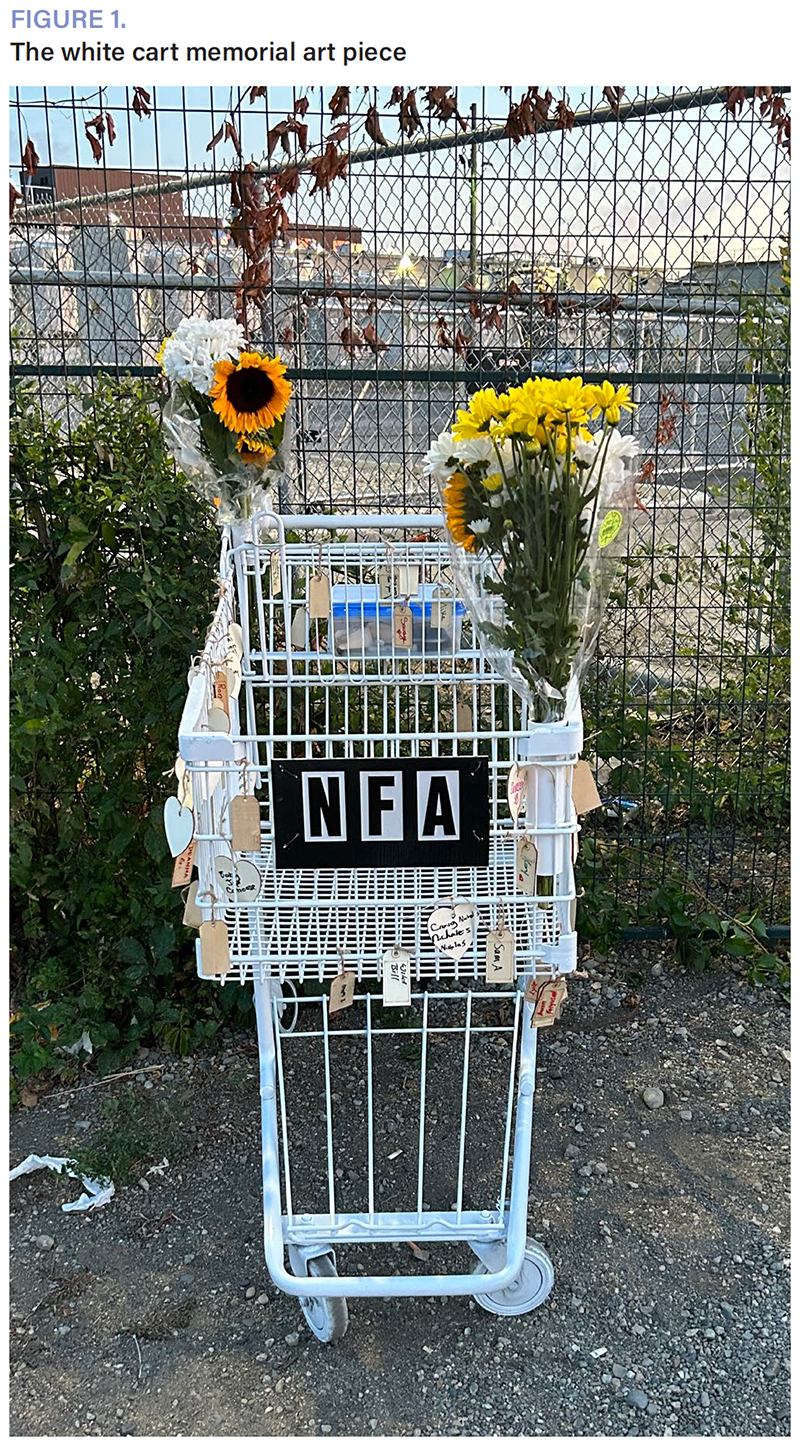
An example of a memorial for this population where names were written on tags and added to an art piece lives on the traditional and unceded territory of the Syilx Okanagan Nation in the city colonially known as Kelowna, BC. It was organized by members of our research team and the Lived Experience Circle on Homelessness (LECoH) in 2023. We gathered with Edna Terbasket of Ki-Low-Na Friendship Society and Westbank First Nations Elder Grouse Barnes. The memorial ceremony included an opening prayer, a eulogy to honour all those who have died, a drumming circle and smudging. We completed the event with food and developed a memorial art piece together, which was suggested by LECoH members – a white shopping cart with the initials NFA on the front, which stands for No Fixed Address (see Figure 1).
| BOX 1. Improving grief supports: lived or living experience perspectives |
|
At the event, people took time to adorn the cart with the names of those they had lost. It was respectfully taken to Outdoor Sheltering Site 4 (OS4) in Kelowna, placed next to a rock memorial that honours the death of a beloved member of the community (see Figure 2). Unfortunately, in 2025, the rock memorial was mistakenly removed by city workers and no longer exists. Discussions are underway to make the white cart a permanent memorial.
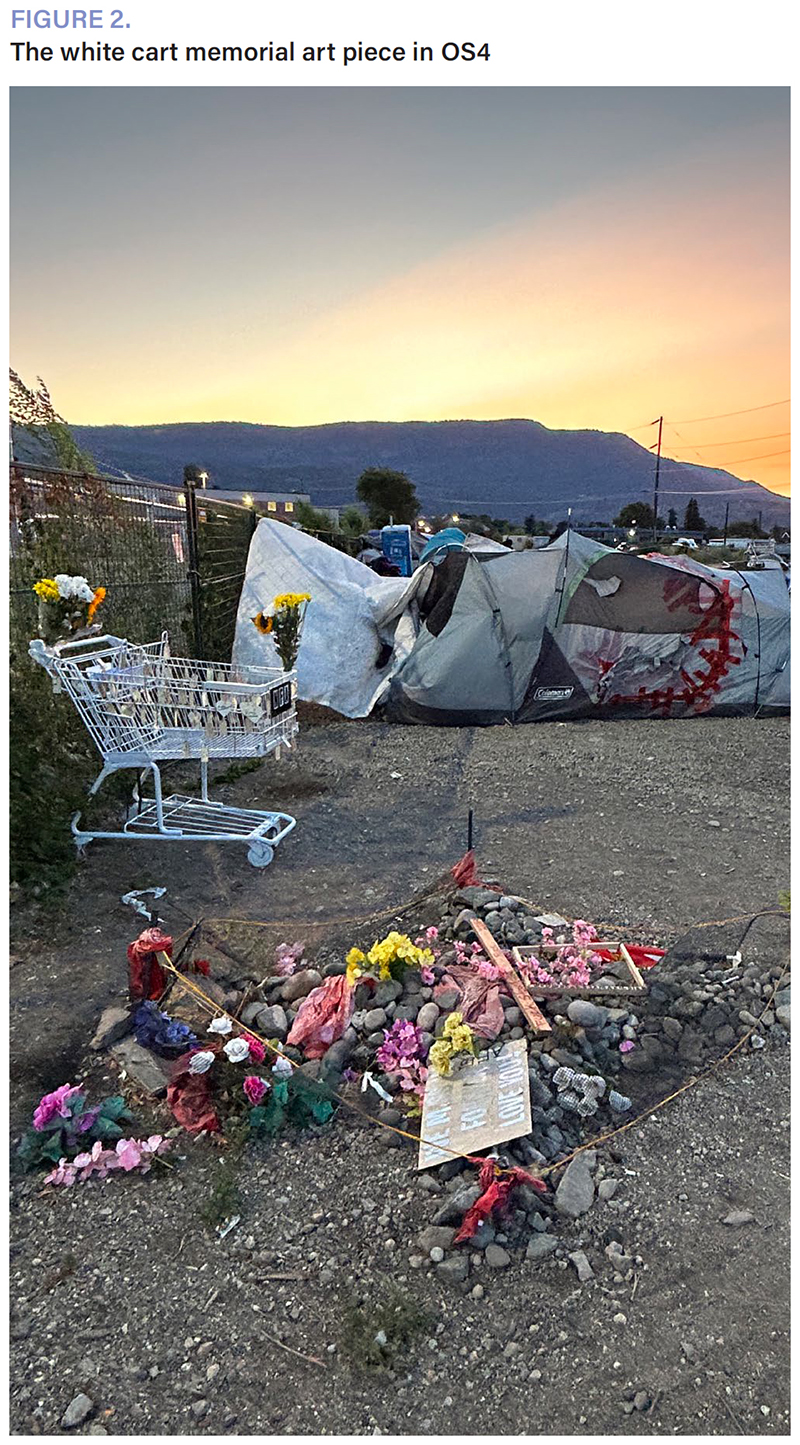
We continued to leave markers and tags in the cart to encourage the memorial art piece to grow. We have heard many stories of how the cart has been accepted by the community and used to process their grief. For example, when someone is grieving the death of someone they cared about, a community member may push the cart to their tent and the bereaved will push it back when they are ready. This art piece was the focus of the documentary, “No Fixed Address: The White Cart Memorial” (Black and Laing 2025), which is available at whitecart.ca.
What's haunting is that people are not able to say goodbye to their people. This white cart gives a place where people can. The white cart also catches people's attention very quickly, which we hope helps people to become more aware of their issues and open their hearts to this community (Sherry Landry).
Lessons Learned From Our Experiences
The importance of taking time to develop the right partnerships
It takes time to build trust with new organizations, and this cannot be rushed. The BCCPC and KHRC were a new partnership that had a similar passion to explore this topic further. It took time to build trust with each other, but as we did, we continued to work closely together on further projects. We each brought different developed partnerships to help these projects. KHRC had already established a relationship with LECoH from years of working together, and because of our partnership with LECoH and building the memorial white cart with them, we were able to get funding to do further research and knowledge translation projects together (e.g., the documentary film). In relation to health system leaders, this means partnering with organizations that have built trust with this community and going to these spaces to offer services, rather than requiring people to come to them.
Building trust with the community
When doing research or knowledge translation projects, it is important to build trust with the community you are hoping to serve. Having the right partnerships is important with organizations they trust, and you need to go to them. You also need to build the right team to facilitate trust, as one member who causes additional trauma can fracture it. In our research, we had both an Indigenous peer researcher and a grief therapist complete the interviews to help support the emotions and experiences of the participants. We spent time thinking about how to create a safe(r) and supported environment for the bereaved. We provided choices in room design for participants (when possible), drop-in timeslots and appointments, lots of snacks and drinks to choose from, options of coping supplies and time to debrief following the interview. By honouring those who participated in our research and the community as a whole, we felt the memorial ceremony was an important way to give back and show our gratitude. There have been too many research teams who have come into these communities and just taken their stories to never be heard from again. In relation to health system leaders, trust has been broken many times, and it will take the required training and partnering with organizations to rebuild this.
Importance of integrating Indigenous perspectives
It is important to recognize that there is a disproportionate number of First Nations, Inuit and Métis individuals experiencing homelessness. According to the 2020–2022 national Point-in-Time count (Government of Canada 2024), 31% of individuals experiencing homelessness in Canada identified as Indigenous, despite making up only 5% of the Canadian population according to Statistics Canada from the 2021 census (Statistics Canada 2023).
The history of colonization in Canada has had, and continues to have, profound impacts on Indigenous Peoples, including the loss of land, culture, language and lives (Prince 2026). This history directly relates to why these numbers are so disproportionate, as well as the grief and trauma people carry from past and ongoing impacts of colonization, including direct and intergenerational trauma from the Residential School System and other colonial structures, policies and systems. It is important to understand the importance of the calls to action for reconciliation. Co-author and Indigenous peer researcher, Sherry Landry, integrated her Indigenous beliefs into the research design, and we had additional Indigenous individuals who helped our team create knowledge translation projects. It is important that health system leaders provide cultural safety training to their workers, as well as integrate Indigenous perspectives into the programs and policies.
Importance of supporting community service providers
Community service providers are often the main, if not only, support for those who are bereaved and experiencing homelessness. Service providers need to be better supported in the workplace to increase their grief and bereavement literacy (Monk et al. 2024, 2025). In addition, organizations and teams that serve those experiencing homelessness need to continue developing compassionate workplaces to honour the grief of the staff when a client dies. Research has found that it is common for these workers to have their own professional grief from the death of clients and that grief can be disenfranchised (Giesbrecht et al. 2023; Monk et al. 2024, 2025; Whitlock et al. 2025). One approach to improve the way we support workers is to provide collective grieving opportunities for staff, such as collective debriefing following a death(s) as a team (CBC Radio 2019; Equity in Palliative Approaches to Care 2023). In relation to health system leaders, this means recognizing the impact of workplace grief on staff and the need to honour it.
Future Directions
Much work still needs to be done at the individual, organizational and system levels to ensure that we can create safer spaces for bereaved people experiencing homelessness to share their experiences and to grieve. This article highlights the need for greater support in the ways that participants have defined for themselves as needing. Only by working together can we build a greater support network for those experiencing homelessness and those who serve them.
About the Author
Joshua Black, PhD, is the bereavement initiative manager at the BC Centre for Palliative Care (BCCPC), BC. Joshua is a grief and bereavement researcher, speaker and host of The Grief Dreams Podcast, with a dedication to raising awareness of those who are bereaved and are not being provided the necessary bereavement support.
Joshua Black can be reached by e-mail at jblack@bc-cpc.ca.
Stephanie Laing, PhD(c), MSW, RSW, is the director of operations at the Kelowna Homelessness Research Centre, Kelowna, BC. Stephanie is a PhD candidate at the University of Calgary, Calgary, AB, and has a long-standing interest in forensic social work, psychiatry and homelessness and is an enthusiastic advocate for reciprocal and responsive community-situated research.
Rachel Carter, PhD, is the director of research at BCCPC and an adjunct professor in the Division of Palliative Care at University of British Columbia (UBC), Vancouver, BC. Rachel is a palliative care researcher with an interest in improving equity in access and quality of palliative care received by people experiencing health and social inequities.
Sherry Landry, HSW (Human Service Worker), is a research assistant at BCCPC and a lived experience adviser with the Lived Experience Circle on Homelessness (LECoH), Kelowna, BC. Sherry, with Dene, Cree and Métis ancestry, has been part of many grassroots movements, uses harm reduction approaches and Traditional Ecological Knowledge and has signed the first Aboriginal Enhancement Agreement on West Bank First Nations with School District #23.
John R. Graham, PhD, is the principal investigator at the Kelowna Homelessness Research Centre, Kelowna, BC. John is a professor and the former director of the School of Social Work (UBC Okanagan campus), Kelowna, BC, and he co-organized the 2009 2nd National Conference on Homelessness and Housing, which led to the creation of what became part of the Canadian Observatory on Homelessness.
Eman Hassan, MD, MPH, is the executive director of BCCPC and an adjunct professor at UBC's Palliative Medicine Division, Vancouver, BC. Eman leads the Centre's collaborative and evidence-based efforts to enhance equitable access to palliative care and bereavement support across British Columbia, while her research focuses on homelessness and bereavement, co-creating resources with those with lived experience.
References
BC Centre for Palliative Care (BCCPC). 2023. Collaborative Action Plan for Accessible, Appropriate, and Equitable Grief and Bereavement Support in British Columbia: An Evidence-Informed Approach. Retrieved February 21, 2025. <https://www.bc-cpc.ca/wp-content/uploads/2023/11/Bereavement-in-BC-Action-Plan-Full-Report.pdf>.
Black, J. and S. Laing (Directors). 2025. No Fixed Address: The White Cart Memorial [Film]. Paul Cotton Films.
Black, J. and S. Landry. 2024, August 7. Bereavement in the Context of Homelessness. BC Centre for Palliative Care – Grief & Bereavement ECHO. YouTube. Retrieved February 21, 2025. <https://www.youtube.com/watch?v=nEpQLK1_-98>.
CBC Radio. 2019, March 8. Palliative Care Team Helps the Homeless Die “With Dignity,” A Healing Circle Helps Them Grieve. Retrieved February 21, 2025. <https://www.cbc.ca/radio/whitecoat/palliative-care-team-helps-the-homeless-die-with-dignity-a-healing-circle-helps-them-grieve-1.5048409>.
Collins English Dictionary. 2012. Bereavement. In Collins English Dictionary – Complete & Unabridged 2021 digital edition. Retrieved September 21, 2025. <https://www.collinsdictionary.com/dictionary/english/bereavement>.
Doka, K.J. 1989. Disenfranchised Grief: Recognizing Hidden Sorrow (1st ed.). Jossey Bass.
Equity in Palliative Approaches to Care. 2023. Palliative Care Is … A Collective Response to Death, Dying, and Grief in the Inner City. University of Victoria. Retrieved September 1, 2026. <https://palliativeapproaches.uvic.ca/wp-content/uploads/2024/03/Palliative-care-is-DIGITAL-2024-03-01.pdf>.
Giesbrecht, M., A. Mollison, K. Whitlock and K.I. Stajduhar. 2023. “Once You Open That Door, It's a Floodgate”: Exploring Work-Related Grief Among Community Service Workers Providing Care for Structurally Vulnerable Populations at the End of Life Through Participatory Action Research. Palliative Medicine 37(4): 558–66. doi:10.1177/02692163221139727.
Government of Canada. 2024, January 26. Everyone Counts 2020–2022 – Results From the Third Nationally Coordinated Point-in-Time Counts of Homelessness in Canada. Retrieved February 21, 2025. <https://housing-infrastructure.canada.ca/homelessness-sans-abri/reports-rapports/pit-counts-dp-2020-2022-results-resultats-eng.html#toc_3>.
Health Canada. 2018, December 4. Framework on Palliative Care in Canada. Retrieved September 1, 2025. <https://www.canada.ca/content/dam/hc-sc/documents/services/health-care-system/reports-publications/palliative-care/framework-palliative-care-canada/framework-palliative-care-canada.pdf>.
Mayock, P., S. Parker and A. Murphy. 2021. Family “Turning Point” Experiences and the Process of Youth Becoming Homeless. Child & Family Social Work 26(3): 415–24. doi:10.1111/cfs.12823.
Monk, J., J. Black, R.Z. Carter and E. Hassan. 2024. Bereavement in the Context of Homelessness: A Rapid Review. Death Studies 48(6): 561–70. doi:10.1080/07481187.2023.2246134.
Monk, J., J. Black, R.Z. Carter and E. Hassan. 2025. Frontline Workers' Perspectives Considering the Dual Experience of Bereavement in the Context of Homelessness in British Columbia, Canada [Manuscript in preparation]. BC Centre for Palliative Care.
Prince, H. 2026. Engaging in a Relational Approach: Addressing Inequities in Access to Palliative Care for Indigenous Peoples. Healthcare Quarterly 29(Special Issue): 15–21. doi:10.12927/hcq.2026.27968.
Stajduhar, K.I., A. Mollison, M. Giesbrecht, R. McNeil, B. Pauly, S. Reimer-Kirkham et al. 2019. “Just Too Busy Living in the Moment and Surviving”: Barriers to Accessing Health Care for Structurally Vulnerable Populations at End-Of-Life. BMC Palliative Care 18: 11. doi:10.1186/s12904-019-0396-7.
Statistics Canada. 2023, February 1. Indigenous Peoples – 2021 Census Promotional Material. Retrieved September 1, 2025. <https://www.statcan.gc.ca/en/census/census-engagement/community-supporter/indigenous-peoples>.
Whitlock, K., Z. Premji, A. Mollison, C. Posada, M. Arias-Rojas, C. Futcher et al. 2025. Work-Related Grief and Bereavement Experiences of Social and Community Service Workers Working With People Experiencing Social Disadvantage: A Rapid Scoping Review. BMC Palliative Care 24: 25. doi:10.1186/s12904-025-01668-8.
Comments
Be the first to comment on this!
You must sign in to comment Sign In or Create an Account to add comments
Related Content
HealthcarePapers
Interrogating Anti-Blackness in US Healthcare: Contextual Factors and Policy Implications
HealthcarePapers
Reforming Governance: Careful Advice
HealthcarePapers