


Healthcare Quarterly
Meeting the Needs of an Aging Population: How Older Adults’ Healthcare Experiences in Canada Compare Internationally
Rachel Latus, Ina Sugay, Xinbei Zhao, Abby Thomas, Yasmine Leger, Winnie Chan and Xi-Kuan Chen
Abstract
As Canada's population ages, understanding older adults' experiences with the healthcare system is essential to ensuring high-quality, equitable care. The 2024 Commonwealth Fund International Health Policy Survey of Older Adults (age 65+) offers a unique opportunity to learn from other countries. Among 10 high-income countries surveyed, older adults in Canada were the least likely to feel satisfied with the quality of care they had received over the past year. This may reflect other challenges they reported, like limited access to timely primary care, long wait times, declining care coordination and out-of-pocket costs.
Introduction
Close to one in five Canadians is now 65 years or older (Statistics Canada 2025), with older adults accounting for nearly half of all healthcare spending (CIHI 2024a). As our population ages, understanding how older adults experience the healthcare system is more important than ever.
The 2024 Commonwealth Fund International Health Policy Survey of Older Adults (age 65+) provides a unique opportunity to compare the healthcare experiences of older adults in Canada with those in nine other high-income countries, namely Australia, France, Germany, the Netherlands, New Zealand, Sweden, Switzerland, the UK and the US (CIHI 2025). A total of 16,737 interviews were completed, which included 3,989 older adults in Canada who took part in telephone surveys between February and June 2024. Results were weighted to reflect the overall Canadian population age 65+, then compared with those of our international peers.
Meeting the Needs of an Aging Population
The survey highlighted the diverse healthcare needs of older adults in Canada. While two in five – higher than the international average – reported excellent or very good health, most were managing at least one common chronic condition, and almost half were taking four or more medications (Table 1).
| TABLE 1. Selected health characteristics of older adults in Canada and internationally | |||
| Topic | Proportion of older adults who reported… | Canada | International average |
| Medical complexity | Excellent or very good health | 41% | 33% |
| Managing at least one common chronic condition | 84% | 83% | |
| Taking four or more medications | 44% | 42% | |
| Notes: The international average was calculated by adding the results from all countries and dividing by the number of countries. The Canadian average represents the average experience of Canadians (as opposed to the mean of provincial results). Source: The Commonwealth Fund, 2024 International Health Policy Survey of Older Adults. |
|||
Older adults in Canada were also the least likely to feel satisfied with their overall care over the past year compared with the other countries surveyed, with over one in four who had received care saying that they were not at least somewhat satisfied. Satisfaction rates varied across the country – from 59% in Newfoundland and Labrador to 77% in Ontario – although all provinces scored below the international average (Figure 1).
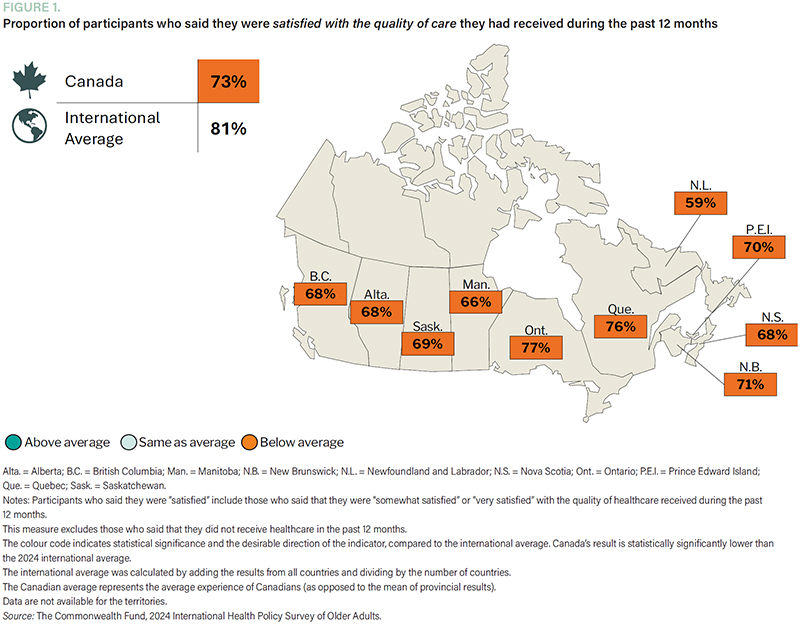
Differences in satisfaction rates can reflect many factors, including expectations and cultural norms. That said, these results suggest that our health system may not be keeping pace with the needs of some older adults. The following sections explore some factors that might contribute to this gap – specifically, challenges in accessing primary care, coordination and continuity of care across health sectors and affordability of healthcare services.
Access to primary care
Over nine in 10 older adults in Canada have a regular doctor or place of care, such as a health centre or clinic (Table 2). While encouraging, this was the lowest rate among the 10 countries surveyed. In Canada, rates were lowest among those with lower incomes (88% in the lowest income quintile vs. 96% in the highest) or living in a rural area (88% vs. 93% among urban residents).
| TABLE 2. Older adults in Canada have less access to timely primary care than their international peers | |||
| Topic | Proportion of older adults who reported… | Canada | International average |
| Access to primary care | Having a regular doctor or place of care | 92% | 97% |
| Emergency department use | Visiting a hospital emergency department in the past two years | 40% | 32% |
| Feeling that they could have been treated in their regular place of care, had it been available* | 31% | 27% | |
| *This measure excludes those who did not visit a hospital emergency department in the past two years. | |||
| Notes: The international average was calculated by adding the results from all countries and dividing by the number of countries. | |||
| The Canadian average represents the average experience of Canadians (as opposed to the mean of provincial results). | |||
| Source: The Commonwealth Fund, 2024 International Health Policy Survey of Older Adults. | |||
Timely access is an even bigger challenge. Only one in four older adults in Canada reported being able to get a same- or next-day appointment with a doctor or nurse the last time they needed one. Again, this was the lowest rate among all countries surveyed, with both Canada's result and the international average declining significantly from previous surveys in 2021 and 2017 (Figure 2).
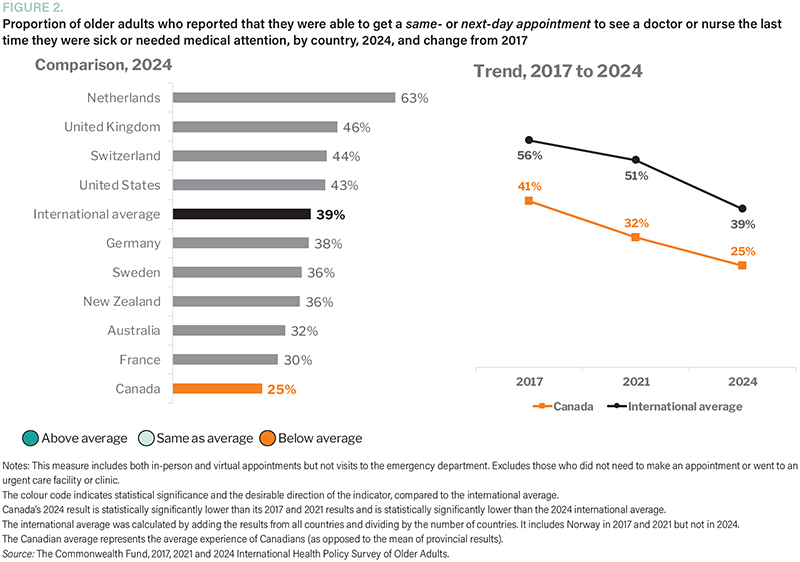
These challenges may be related to several factors, including a slowing growth rate of new family physicians, more family physicians choosing to provide specialized care, increasing patient complexity causing physicians to see fewer patients overall on average, administrative demands, and policy changes (CIHI 2024b).
When people cannot access timely primary care they may turn to emergency departments instead, resulting in fragmented care and increased cost to the healthcare system (CIHI 2024c). Among older adults in Canada who reported using a hospital emergency department in the past two years, almost one in three felt they could have been treated in their usual place of care had it been available (Table 2).
Beyond primary care: Coordination and continuity across sectors
Older adults often have complex health needs requiring coordination across multiple providers and sectors beyond primary care. Timely referrals and access to specialized services, as well as adequate support in the community, are essential to meeting their overall care needs.
Canada has consistently performed well in care coordination compared to international peers. Among older adults who saw multiple health providers, for example, two in three said that their regular doctor “always or often” helped coordinate their care. That said, the data show a clear downward trend in both Canada and peer countries. Furthermore, there is significant variation across provinces – from 50% in Quebec, below the international average, to 76% in Alberta (Figure 3).
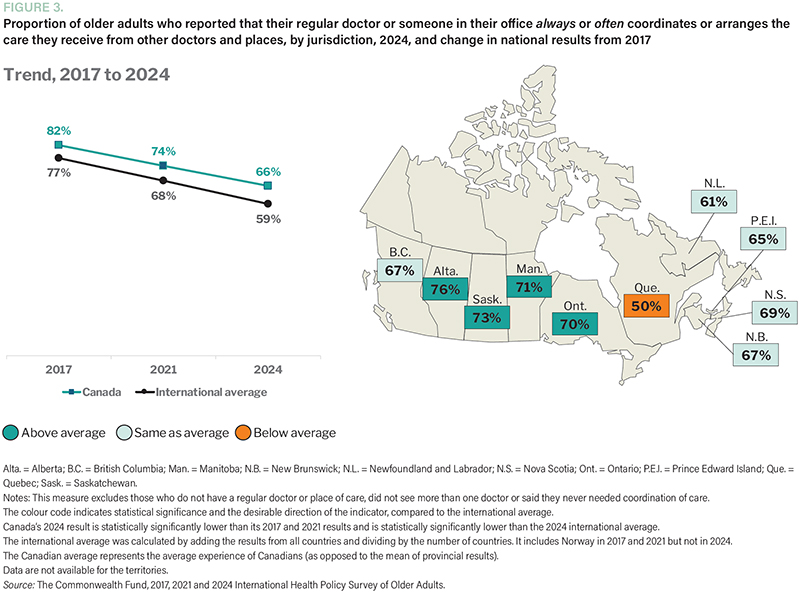
Older adults in Canada also face long wait times when accessing specialized care. Among those who saw or needed to see a specialist, nearly half waited at least two months for an appointment, and one in 10 waited a year or more (Table 3).
| TABLE 3. Older adults in Canada report longer waits for specialized care, and may rely more on informal help from family, friends and community members to manage limitations in daily activities | |||
| Topic | Proportion of older adults who reported… | Canada | International average |
| Wait times to see a specialist | Waiting two months or more to see a specialist* | 46% | Germany: 25%§ Switzerland: 10%§ |
| Waiting a year or more to see a specialist* | 10% | Germany: 1%§ Switzerland: 1%§ |
|
| Mental healthcare | Being diagnosed with a mental health condition | 14% | 12% |
| Receiving counselling or treatment, among those with a formally diagnosed mental health condition | 31% | 37% | |
| Wanting or needing treatment, among those who did not receive counselling or treatment and had a formally diagnosed mental health condition | 38% | 33% | |
| Care at home | Being at least somewhat limited in their daily activities | 17% | 18% |
| Receiving professional help¶ | 16% | 14% | |
| Receiving informal help from family members, friends or community members¶ | 30% | 24% | |
| * This measure excludes those who did not need to see a specialist. | |||
| § International average not calculated, as this question was only asked in three countries. | |||
| ¶ Excludes those who were not at least somewhat limited in their daily activities. | |||
| Notes: The international average was calculated by adding the results from all countries and dividing by the number of countries. | |||
| The Canadian average represents the average experience of Canadians (as opposed to the mean of provincial results). | |||
| Source: The Commonwealth Fund, 2024 International Health Policy Survey of Older Adults. | |||
In some cases, access challenges may prevent older adults from receiving the specialized care they want or need. For example, among older adults in Canada who reported being formally diagnosed with a mental health condition, fewer than one in three received counselling or treatment in the past year – even though 38% of those who did not receive counselling or treatment said that they wanted or needed it (Table 3).
In addition to services provided in formal care settings like clinics or hospitals, some older adults require extra help at home. Among older adults in Canada who reported being at least somewhat limited in their daily activities, only 16% received professional help, while 30% received informal help from family members, friends or community members (Table 3). A previous survey of the general population showed that while providing this type of care can be rewarding, 59% of caregivers found it stressful and 93% received no financial support (CIHI 2024d).
Together, these findings suggest that while Canada continues to perform well in care coordination, emerging declines in this area and unmet needs for specialized care may be contributing to more fragmented experiences for older adults.
Affordability of healthcare services
Even within Canada's publicly funded health system, cost remains a barrier for some. In this survey, two in five older adults in Canada reported spending the equivalent of at least $500 USD out-of-pocket on healthcare services, excluding insurance premiums. Furthermore, fewer than half said that they had private insurance to help cover these costs (Table 4).
| TABLE 4. Out-of-pocket costs may be a barrier for some older adults, preventing them from accessing needed healthcare | |||
| Topic | Proportion of older adults who reported… | Canada | International average |
| Out-of-pocket costs | Spending at least $500 USD out-of-pocket on healthcare services, excluding insurance premiums | 40% | 38% |
| Having private insurance to help cover healthcare costs | 45% | 48% | |
| Trade-offs due to cost | Skipping a dental visit | 22% | 14% |
| Not filling a prescription, or taking fewer doses | 6% | 5% | |
| Skipping a recommended test or treatment | 5% | 5% | |
| Notes: The international average was calculated by adding the results from all countries and dividing by the number of countries. | |||
| The Canadian average represents the average experience of Canadians (as opposed to the mean of provincial results). | |||
| Source: The Commonwealth Fund, 2024 International Health Policy Survey of Older Adults. | |||
Some older adults even reported skipping care due to cost, including skipping a dental visit, not filling prescriptions or taking fewer doses and skipping recommended tests or treatment (Table 4).
For those on low or fixed incomes, even modest costs can lead to postponed care, poorer health outcomes and lower overall care satisfaction.
Conclusions
While most older adults are satisfied with their care, the results of the 2024 Commonwealth Fund Survey of Older Adults highlight several areas where Canada could learn from international peers – particularly in increasing access to primary and specialized care services, strengthening care coordination and addressing out-of-pocket costs.
These challenges are not new, but they are becoming increasingly visible as our population ages. Addressing them through targeted policies will be essential to ensuring that older adults in Canada receive timely, person-centred care – enabling them to remain healthy and live independently at home for longer while reducing strain on our hospitals and caregivers.
About the Author(s)
Rachel Latus, MSc, is a senior analyst at the Canadian Institute for Health Information (CIHI) in Ottawa, ON. Rachel Latus can be reached by e-mail at rlatus@cihi.ca.
Ina Sugay, BSc in progress, is a student at the University of Toronto and a former co-op student at CIHI in Toronto, ON.
Xinbei Zhao, MSc, MBA, is a senior analyst at CIHI in Ottawa, ON.
Abby Thomas, MSc, is a senior analyst at CIHI in Ottawa, ON.
Yasmine Leger is a senior coordinator at CIHI in Ottawa, ON.
Winnie Chan, MPH, is a project lead at CIHI in Toronto, ON.
Xi-Kuan Chen, Phd, is a manager at CIHI in Toronto, ON.
References
Canadian Institute for Health Information (CIHI). 2024a. National Health Expenditure Trends, 2024 – Infographics. Retrieved October 17, 2025. <https://www.cihi.ca/en/national-health-expenditure-trends-2024-infographics#:~:text=Health%20care%20spending%20is%20highest,2012%20and%200.9%25%20in%202022>.
Canadian Institute for Health Information (CIHI). 2024b. The State of the Health Workforce in Canada, 2023. Retrieved October 25, 2025. <https://www.cihi.ca/en/the-state-of-the-health-workforce-in-canada-2023>.
Canadian Institute for Health Information (CIHI). 2024c. Measuring Primary Care Access Through Emergency Department Use. Retrieved October 25, 2025. <https://www.cihi.ca/en/primary-and-virtual-care-access-emergency-department-visits-for-primary-care-conditions/measuring-primary-care-access-through-emergency-department-use>.
Canadian Institute for Health Information (CIHI). 2024d. Commonwealth Fund Survey, 2023. Retrieved October 17, 2025. <https://www.cihi.ca/en/commonwealth-fund-survey-2023>.
Canadian Institute for Health Information (CIHI). 2025. Commonwealth Fund Survey, 2024. Retrieved October 25, 2025. <https://www.cihi.ca/en/commonwealth-fund-survey-2024>.
Statistics Canada. 2025. Older Adults and Population Aging Statistics. Retrieved October 17, 2025. <https://www.statcan.gc.ca/en/subjects-start/older_adults_and_population_aging>.
Comments
Be the first to comment on this!
Personal Subscriber? Sign In
Related Articles


Note: Please enter a display name. Your email address will not be publically displayed